Vegetables Pulao (Vegitabls Palao) Recipe

Ingredients:
  • - 1 cup basmati rice (soaked in warm water for 30 minutes)
  • - 2 cups mixed chopped vegetables (any combination of green beans, carrots, spinach, cauliflower, peas, etc)
  • - 1 onion, sliced thin
  • - 1 bay leaf
  • - 1 medium-hot red chilli, sliced into very thin rings
  • - 3-4 green chillies, slit (optional or adjust to taste)
  • - 1/2 tsp garam masala
  • - 1 tsp cumin seeds
  • - 1 tsp slivered garlic (2-3 pods)
  • - 1 tsp ginger root, grated
  • - 2 tsp oilSalt to taste
  • - 1 tbsp coriander leaves, to garnish
  • - Handful of roasted/fried cashewnuts, for garnish (optional)
Method:
  1. - Heat the 2 tsp oil in a pan and add the bay leaf, garlic, grated ginger, slit chillies, sliced red chilli and cumin seeds. Fry for 30 seconds or so, stirring continuously.
  2. - Add the garam masala and onions and stir-fry till they start turning soft, then add the vegetables and stir again.
  3. - Drain the rice and add that to the pan as well and fry for 2-3 minutes.
  4. - Add 2-1/4 cups water and salt to taste. Pour it all into a microwaveable bowl and cook it for 15 minutes or so on high without a cover. (Start with 10 minutes and see if the vegetables and rice are cooked - the cooking time depends on the wattage of the oven.)
  5. - Cover the bowl and let the pulao rest for 5 minutes.
  6. - Just before serving, fluff the rice up gently with a fork and sprinkle the chopped coriander over. Also top with the fried cashewnuts, if using.
  7. - Serve hot with chilled tomato-yogurt raita.

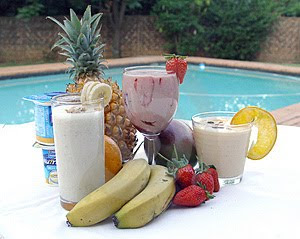
Fruit Smoothies (Frut Smuthies) Recipe

Refreshing, delicious and healthy, fruit smoothies are so easy to make at home that you hardly need a recipe. All you need is a blender and some fresh ripe fruit and you can have a natural and tasty drink in seconds, which will provide you with loads of vitamins, anti-oxidants and minerals. Smoothies are a great way of getting kids to eat their daily five portions of fruit and veg without them even noticing that they are doing so.


In summer you are spoilt for choice with fruit to use in your smoothies: strawberries, raspberries, peaches, apricots. Even gooseberries and blackcurrants make wonderful smoothies, on their own or mixed with other fruits. In winter you can still make great smoothies using frozen berries, but you can also use bananas, mangos, kiwis, oranges, passion fruit, pomegranates and pineapples to add freshness and vitamins to your fruit smoothie.
You can make up your own smoothies with whatever fresh, ripe fruit you have available and mix them with yoghurt or fruit juices. When the fruit is properly ripe you won’t need to add sugar at all making your smoothie even healthier. In summer you can add crushed ice cubes to the mix for instant chill.
Here are a few smoothie recipes to start your imagination going:
1. Cranberry and Raspberry Smoothie
Ingredients
  • - 1 cup cranberries
  • - 1 cup raspberries
  • - 125ml / ½ cup cranberry juice
  • - 1 cup yoghurt

Method:-

  • Blend until smooth. Taste to check for sweetness and add a little more juice if you need it a little sweeter.

2. Mango, Banana and Strawberry Smoothie

Ingredients

  • - 1 mango / 100g chopped mango peeled
  • - 1 small, ripe banana
  • - 3-4 strawberries
  • - Juice of 1 orange

Method:-

  • Blend all the fruit together until smooth.

3. Tropical Smoothie

Ingredients

  • - 1 small pineapple peeled and diced
  • - 1 banana
  • - 1 cup yoghurt
  • - 1 tablespoon dessicated coconut
  • - 1 cup pineapple/orange juice
  • - 1 passion fruit

Method:-

  • Blend together until smooth.

Note:-

Don’t forget you can add extra oomph to your smoothies with a little grated ginger root, or a dash of ground spice. Cardamom, cinnamon, and even coriander can work well to add variety to your smoothie recipes.

You can also turn your smoothies into a liquid health breakfast, by adding ingredients like nuts, flaxseed oil and wheat germ along with the berries and fresh fruit.

Sicilian Vegetable Stew (Sisilian Vegitabal Steu) Recipe

Ingredients

  • - Aubergines 500g
  • - 1 courgette (sliced)
  • - 1 Celery stick (sliced)
  • - 825 ml Extra Virgin Olive Oil
  • - 1 Onion (cut into thin rings)
  • - 2 Peppers (1 Red & 1 Yellow - sliced into strips)
  • - 400g Tin Chopped Tomatoes
  • - 1/2 tbs Dry Basil
  • - 300g Potatoes (diced)
  • - 10g Sugar
  • - 100ml White wine vinegar
  • - 25g Capers
  • - 25g Pine nuts
  • - 25g Raisins
  • - 75g Green olives (stoned and cut into half)
  • - 60g Sun dried tomatoes
  • - Salt and black pepper for seasoning

Method

  • - Dice the aubergines (roughly 2 by 2 cm dice) and put the dice into a colander, sprinkle with lots of salt and leave to rest for a couple of hours. The salt will extract the bitter dark juice from the aubergines. After two hours, rinse the aubergines and pat them dry before frying them.Meanwhile, you have plenty of time to prepare the rest of the vegetables. Slice the courgette into 3 mm thick slices. Do the same with the celery.Peel the skin off the peppers. If your peppers have a full round profile, a peeler will save you lots of hassle; otherwise you can use a pairing knife and with a bit of patience you will get the job done.Then, cut the peppers into strips, roughly 5 cm long and 5 mm thick (I wouldn’t go any thicker than this because it will be more difficult to sauté them).
  • - This is the stage where the vegetables are ready to be fried. The timing for the frying is dictated by the aubergines, which need to go through a self cleaning process before to use them. Once the aubergines are ready, lay the vegetables to be fried onto a kitchen towels and see the next stage.Just before you start frying, revive the raisins soaking them in lukewarm water for about 15-20 minutes, then drain them using a little sieve and set aside.Put the Olive Oil into a pan suitable for deep frying. Heat the oil until it gets the right temperature for frying. Start with the aubergines, frying the dice for about 4 minutes. After 4 minutes, remove the aubergine dice with a slotted spoon and put them into a large bowl lined with kitchen paper, to absorb the excess oil.Using the same oil, fry the courgette for 4 minutes and then put them onto kitchen paper. The same applies for the celery. Fry for 4 minutes and then put the slices onto kitchen paper. Finally, once the excess oil is absorbed, then you can put all three fried vegetables together and set aside. The next step is the initial sauté.
  • - Put the extra virgin Olive Oil into a large pan, bring the heat to medium and gently start to sauté the onion.When the onion starts softening (we would say after 2-3 minutes), add the peppers and continue with the sauté. Give it a good stir so that both the onion and pepper are well coated with oil. Continue cooking until the onion becomes well golden in colour. This is the stage where you add the chopped tomatoes.
  • - Add the chopped tomatoes, the dry basil and the diced potatoes and give it a good stir. If you think the sauce is too dry, there is nothing wrong in adding half a glass (roughly 100 ml) of boiled water.Cover with the lid and cook for about 10 minutes on medium heat. After 10 minuets, add the sugar. Add the vinegar, capers, pine kernels, raisins, green olives, and finally, the sun dried tomatoes (roughly cut into pieces).Season with salt and pepper.
  • - Add the fried vegetables into the pan. Also in this case, if you think that the stew is too dry, half a glass of boiled water will help.Cover with the lid and continue cooking for about 20 minutes over very low heat, gently stirring once or twice. After 20 minutes, remove the pan from the heat and set aside to cool down; traditionally it is best served cold (some people prefer it still hot).Use some home made bread to prepare a bruschetta-like dish. Take a slice of bread and a griddle pan. Once the pan is piping hot, grill the bread on both sides.
  • - Finally, serve the vegetable stew over a slice of bread. Buon appetito! PS: this is where a good glass of south Italian red wine will come handy, to complete this Sicilian experience!

Gulab Jaman (Gulaab Jamun) Recipe


Ingredients

For The Gulab Jamuns

  • 3 cups milk powder
  • 1 cup self raising flour
  • 1/4 tsp baking powder
  • 300ml fresh pouring cream
  • 1/2 tsp cardamom powder
  • 1 tbsp ghee [clarified butter]
For The Syrup
  • 4 cups sugar
    3 cups water
    1 tbsp rosewater
Method
  1. Combine all the ingredients for the Gulab Jamuns in a big bowl and rub the mixture with your fingertips till it starts resembling breadcrumbs.
  2. Knead it well for a few minutes till the resulting dough is smooth.
  3. Cover and leave aside for 30 minutes to cure.
  4. Meanwhile combine sugar and water in a saucepan and simmer, stirring ocassionally for a few minutes on medium heat.
  5. Bring to a boil, remove from heat when the mixture has become thick and syrupy.
  6. Stir in rosewater and keep aside.
  7. Divide the dough into 30 portions and shape them into balls with the palms of your hand.
  8. Make sure there are no cracks in the balls by smoothing out the surface with your fingertips.
  9. Heat oil in a fryer or deep wok/saucepan.
  10. When it starts smoking, reduce heat, wait a minute and then fry the balls on reduced heat, turning them constantly so they brown evenly.
  11. Transfer the fried gulab jamuns to the bowl of syrup and make sure they are well covered with syrup.
  12. They will swell a bit and become soft with the syrup after a few minutes.
  13. Enjoy hot or cold.
Gel's Notes
  • Make sure that you have enough oil in the fryer, so that the gulab jamuns float freely while frying and not stick to the bottom.
  • Adjust the heat while frying so that it is always medium-low when the jamuns are being fried. Slow frying is the key to evenly cooked and browned jamuns.
  • The gulab jamuns will keep well outside in cool weather for 3-4 days or in the fridge for well over a week.

Boondi Laddu (Bundi Ladu) Recipe

Ingredients

For Boondi

  • 2 1/2 cups gram flour (not superfine variety)
  • 500 ml milk
  • 1/2 teaspoon cardamom powder
  • 3 cups ghee (for deep frying)
For Syrup
  • 2 1/2 cups sugar
  • 3 1/2 cups water
  • 2 tablespoons milk
  • 3 drops saffron, colour
Directions
For Boondi:-
  1. Mix flour and milk to a smooth batter.
  2. Heat ghee in a heavy frying pan.
  3. Hold a fine holed shallow strainer spoon on top with one hand. With the other pour some batter all over the holes.
  4. Tap gently till all batter has fallen into hot ghee.
  5. Stir with another strainer and remove when light golden.
  6. Keep aside. Repeat for remaining batter.
  7. Immerse boondi in syrup. (For syrup see note below.)
  8. Drain any excess syrup.
  9. Spread in a large plate.
  10. Sprinkle few teaspoons hot water over it.
  11. Cover and keep for 5 minutes.
  12. Shape in laddoos (like meat balls) with moist palms.
  13. Cool and keep open to dry, before storing in containers.
For Syrup :-
  1. Put sugar and water in a vessel and boil. When sugar dissolves, add milk.
  2. Boil for 5 minutes till dirt forms on top.
  3. Strain and return to fire.
  4. Add colour and boil till sticky but no thread has formed.
  5. Add cardamom powder and mix.
  6. Serve

Roasted Vegetables (Rosted Vegitabals) Recipe

Ingredients
  • 1 small butternut squash, cubed
  • 2 red bell peppers, seeded and diced
  • 1 sweet potato, peeled and cubed
  • 3 Yukon Gold potatoes, cubed
  • 1 red onion, quartered
  • 1 tablespoon chopped fresh thyme
  • 2 tablespoons chopped fresh rosemary
  • 1/4 cup olive oil
  • 2 tablespoons balsamic vinegar
  • salt and freshly ground black pepper


Directions
  1. Preheat oven to 475 degrees F (245 degrees C).
  2. In a large bowl, combine the squash, red bell peppers, sweet potato, and Yukon Gold potatoes.
  3. Separate the red onion quarters into pieces, and add them to the mixture.
  4. In a small bowl, stir together thyme, rosemary, olive oil, vinegar, salt, and pepper. Toss with vegetables until they are coated.
  5. Spread evenly on a large roasting pan.
  6. Roast for 35 to 40 minutes in the preheated oven, stirring every 10 minutes, or until vegetables are cooked through and browned.